

Gluten-Free Products Market Forecast 2026-2036: Global Market to Reach USD 13.2 Billion by 2036 at 7.0% CAGR
Gluten-free Product Market
Gluten-free foods shift from niche medical need to mainstream lifestyle staple, driven by diagnosis expansion and retail normalization.
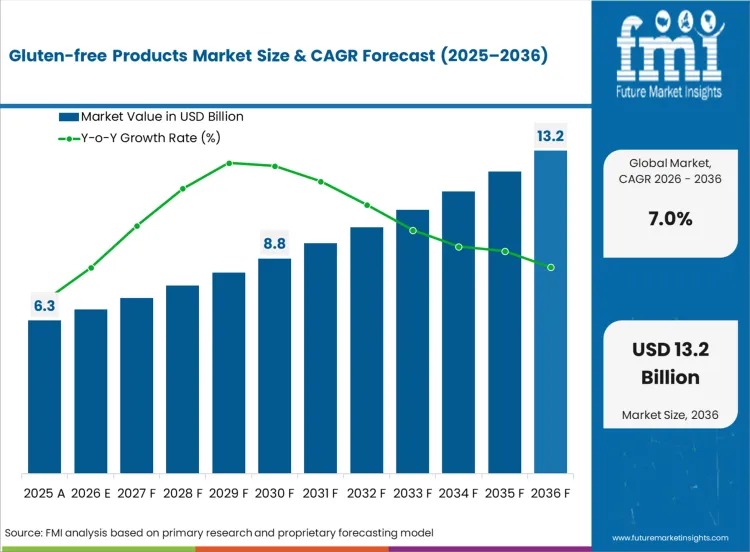
NEWARK, DE, UNITED STATES, March 2, 2026 /EINPresswire.com/ -- The global gluten-free products market is transitioning from a niche dietary segment into a mainstream food industry pillar. Valued at USD 6.3 billion in 2025, the market is projected to reach USD 6.7 billion in 2026 and surge to USD 13.2 billion by 2036, expanding at a CAGR of 7.0%. An absolute dollar opportunity of USD 6.5 billion over the decade underscores a structural shift where “free-from” attributes are becoming baseline consumer expectations rather than premium differentiators.
Procurement specifications across global retail chains are rapidly evolving, particularly in the United States, where leading brands are reformulating flagship SKUs to capture lifestyle consumers while retaining medically dependent buyers. With nearly 83% of individuals with celiac disease remaining undiagnosed or misdiagnosed, the addressable market holds significant latent expansion potential as screening protocols improve.
Request For Sample Report | Customize Report | Purchase Full Report - https://www.futuremarketinsights.com/reports/sample/rep-gb-490
Market Definition and Scope
The gluten-free products market comprises food and beverage items formulated without wheat, barley, rye, or triticale, processed to meet regulatory thresholds (typically <20 ppm gluten). The category spans gluten-free bakery premixes, bread, cookies, snacks, pasta, ready meals, and specialty flours sold across retail, foodservice, and D2C channels.
Excluded are fresh, naturally gluten-free foods unless processed and explicitly labeled for certification compliance.
Demand Drivers Accelerating Growth
Growth is anchored in both medical necessity and lifestyle adoption:
• Rising diagnosis rates of celiac disease and non-celiac gluten sensitivity
• Increasing perception of gluten-free diets as anti-inflammatory and “clean label”
• Ingredient innovation in sorghum, buckwheat, tapioca starch, and rice flour
• Institutional procurement mandates in schools and universities
The “medicalization” of food is evolving into inclusive snacking. Winning brands are integrating gluten-free claims into broader platforms such as high-protein, keto-friendly, or organic positioning.
Segmental Analysis
Ready Meals Lead Product Segmentation
Ready meals are expected to command 42% of market share in 2026. Time-constrained households managing celiac disease rely heavily on certified prepared foods to avoid cross-contamination risks. Microwaveable dinners, gluten-free pizza bases, and frozen ethnic cuisine bowls are transforming the category.
Institutional demand is emerging as a high-margin B2B opportunity. Over 70% of college students with celiac disease report limited dining access, creating procurement gaps for certified ready-meal suppliers.
Convenience Stores Dominate Distribution
Convenience stores are projected to capture 58% of distribution share in 2026, reflecting mainstream penetration. Gluten-free snacks now sit alongside traditional products at competitive price points, normalizing the category for impulse buyers.
Single-serve packaging formats—bars, chips, shakes—reduce planning burdens for consumers managing strict dietary needs. Supply chain depth, supported by vertical integration strategies, ensures consistent shelf availability.
Regional Outlook: Asia Pacific Leads Growth
While North America remains the innovation engine, Asia Pacific is the fastest-growing region due to dietary westernization and improved diagnostic awareness.
Top Country CAGR (2026–2036):
• India: 8.9%
• China: 7.5%
• Brazil: 6.5%
• United States: 5.7%
• United Kingdom: 5.2%
• Germany: 4.6%
India’s growth is supported by millet adoption under FSSAI frameworks, leveraging naturally gluten-free grains repositioned as modern superfoods. China’s expansion is concentrated in Tier-1 urban bakery and premium ready-meal categories.
In Europe, strong labeling standards and medical nutrition awareness sustain steady demand. Germany’s 0.9% celiac prevalence rate and the UK’s 1-in-100 incidence rate underpin consistent ROI visibility for manufacturers.
Latin America, particularly Brazil, is benefiting from regulatory enforcement of <20 ppm labeling thresholds, fostering consumer trust and unlocking packaged goods investment.
Competitive Landscape: Consolidation and Line Extensions
The competitive environment is bifurcated between heritage specialists and multinational entrants.
Dr. Schär continues to consolidate its European footprint, including acquisition of Hero Group’s gluten-free business. This “buy-and-build” model secures dedicated manufacturing capacity—critical in avoiding cross-contamination risks.
Meanwhile, multinational players such as General Mills and The Kraft Heinz Company are leveraging distribution muscle via line extensions.
Saco Foods strengthened its portfolio through aggregation of Ancient Harvest and Pamela’s Products, enabling cross-category promotions and stronger retail negotiation power.
Strategic Imperatives for Stakeholders
• Invest in dedicated “free-from” manufacturing lines
• Secure IP-preserved grain sourcing through acquisitions
• Expand grab-and-go formats for impulse retail
• Develop hybrid SKUs combining gluten-free with high-protein or keto claims
• Explore ancient grain differentiation strategies
Market Restraints and Opportunity Matrix
Despite robust growth, price premiums—often 200–500% above conventional wheat products—remain a barrier in price-sensitive markets. Sensory replication challenges persist in artisan bread and bakery applications.
However, verticalized supply chains and farm-to-fork traceability models are building trust among hyper-vigilant consumers. Hybrid functionality, combining gluten-free with nutritional density, presents significant untapped opportunity.
About the Report
This analysis is based on primary interviews with R&D leaders, certification bodies, and retail category managers, combined with bottom-up revenue aggregation from certified gluten-free brands. Data validation incorporates supplier capacity disclosures and epidemiological benchmarks to ensure industrial accuracy.
Browse Related Insights
Acidity Regulator Market: https://www.futuremarketinsights.com/reports/acidity-regulator-market
Prebiotic Ingredient Market: https://www.futuremarketinsights.com/reports/prebiotic-ingredient-market
Infant Formula Market: https://www.futuremarketinsights.com/reports/infant-formula-market
Agriculture Enzyme Market: https://www.futuremarketinsights.com/reports/agricultural-enzymes-market
Savory Ingredient Market: https://www.futuremarketinsights.com/reports/savory-ingredient-market
Sudip Saha
Future Market Insights Inc.
+ +1 347-918-3531
email us here
Legal Disclaimer:
EIN Presswire provides this news content "as is" without warranty of any kind. We do not accept any responsibility or liability for the accuracy, content, images, videos, licenses, completeness, legality, or reliability of the information contained in this article. If you have any complaints or copyright issues related to this article, kindly contact the author above.
