

Global Railway System Market Projected to Reach USD 50 Billion in 2036 Amid Urbanization and Decarbonization Shifts
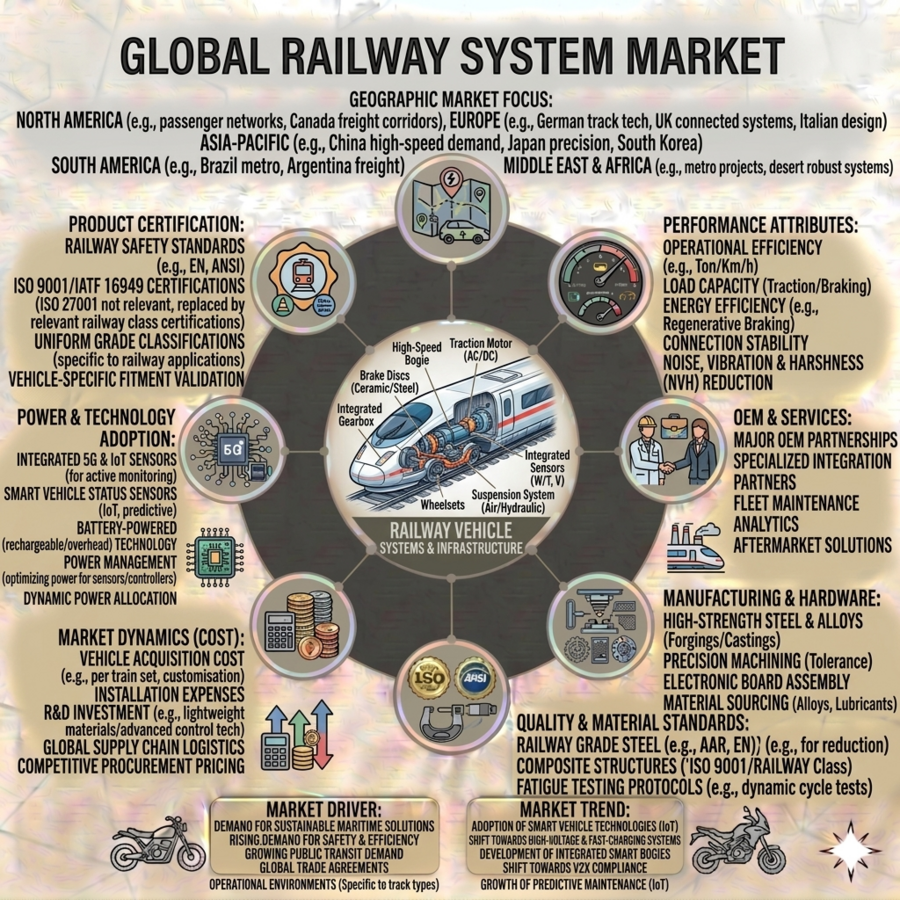
Railway System Market
The railway system market is valued at USD 32.5 billion in 2026 and projected to reach USD 50.0 billion by 2036 at a CAGR of 4.4%.
NEWARK, DE, UNITED STATES, April 2, 2026 /EINPresswire.com/ -- As global metropolitan centers grapple with unprecedented congestion and nations race toward ambitious net-zero targets, the backbone of terrestrial mobility is undergoing a high-tech renaissance. According to the latest strategic industry analysis, the Global Railway System Market is valued at USD 32.5 billion in 2026 and is forecasted to climb to USD 50.0 billion by 2036, representing a steady CAGR of 4.4%.
This growth trajectory is fundamentally anchored in public capital planning cycles and multi-year infrastructure frameworks. Unlike consumer tech sectors characterized by rapid turnover, the railway market is defined by asset longevity and disciplined, tender-based procurement. Expenditure is increasingly concentrated in high-density corridors where the sheer volume of passengers and freight tonnage justifies the significant capital intensity required for rail deployment.
Get Access of Report Sample:
https://www.futuremarketinsights.com/reports/sample/rep-gb-16380
Urban Mobility at the Forefront: The Rise of Rapid Transit
The most significant shift in the current landscape is the overwhelming demand for urban integration. Rapid Transit Systems currently hold a dominant 54.3% share of the global market. Metro and subway projects are no longer viewed as luxury infrastructure but as essential survival tools for "megacities" where road expansion is physically impossible.
By prioritizing grade-separated systems, city planners are achieving a level of operational reliability that road-based transport cannot match. This focus is mirrored in the application data, where Passenger Transportation accounts for 59.1% of the market. The social mandate for accessible, frequent, and reliable commuting options is driving state and municipal governments to commit to long-term electrification and signaling upgrades, ensuring that the rail networks of 2036 are not just larger, but significantly smarter.
Regional Growth Leaders: South Korea and the USA Set the Pace
While rail is a global industry, the intensity of investment is highly localized, following regions that prioritize continuous renewal and high-tech optimization.
South Korea leads the world in growth intensity with a 4.7% CAGR. This expansion is driven by a sophisticated integration of high-speed intercity lines with dense metropolitan commuter networks. The Korean model emphasizes advanced signaling and low-emission rolling stock, serving as a global blueprint for digital rail transition.
In the United States, a 4.6% CAGR reflects a historic pivot toward infrastructure renewal. After decades of highway dominance, federal funding is now flowing into the modernization of aging freight corridors and the revitalization of urban transit links. The focus here is on improving the reliability of existing assets while integrating digital control systems to increase throughput on shared passenger-freight tracks.
The United Kingdom follows with a 4.3% CAGR, where the narrative is centered on "digital signaling" and full-network electrification. As a mature rail economy, the UK’s growth stems from the necessity of squeezing more capacity out of a Victorian-era footprint, using technology to ensure service punctuality and safety compliance.
Japan (4.2% CAGR) continues to demonstrate the value of operational precision. Its investment is focused on disaster resilience—specifically seismic and climate-related risk mitigation—and the continuous replacement of high-intensity urban assets. Meanwhile, China (4.1% CAGR) is transitioning from its historic "mega-expansion" phase toward a period of optimization, focusing on regional connectivity and the efficiency of its existing, world-leading high-speed network.
The Intelligence Transition: Signaling, Electrification, and AI
The railway system of the next decade will be defined by what is invisible to the passenger. Market value is shifting from raw steel and sleepers toward integrated digital control.
Digital Signaling & CBTC: Communication-Based Train Control (CBTC) is allowing metros to run trains closer together with higher safety margins, effectively increasing a tunnel's capacity without digging a new one.
Strategic Electrification: Moving away from diesel is no longer just an environmental choice; it is a financial one. Electrified networks offer significantly lower marginal operating costs per kilometer, a critical factor for public agencies managing tight budgets.
Predictive Maintenance: Using AI and digital asset management tools, operators are now moving away from "scheduled" maintenance toward "predictive" models. By monitoring track and rolling stock health in real-time, authorities can intervene before a failure occurs, drastically reducing the "congestion costs" associated with unplanned downtime.
Competitive Landscape: The Era of Integrated Turnkey Solutions
The competitive environment is consolidating around a few "global giants" capable of delivering end-to-end, turnkey systems. Procurement teams are moving away from piecemeal contracting, preferring partners who can handle everything from rolling stock design to 30-year maintenance cycles.
CRRC Group: Remains the global volume leader, leveraging massive manufacturing scale and a growing export footprint to dominate large-scale rolling stock and infrastructure tenders.
Siemens Mobility & Alstom: These European leaders are the standard-setters for digital signaling and high-speed rail. Their focus is on the "system of systems," integrating hardware with sophisticated software layers.
Hitachi Rail & Stadler Rail: These players are carving out significant market share by focusing on modularity and specialized regional solutions, such as battery-electric trains for non-electrified branch lines and high-precision urban metro systems.
Frequently Asked Questions (FAQ)
1. Why does the railway market grow more slowly than other tech sectors?
Railway systems are "long-life assets." A locomotive or a signaling system is expected to last 30 to 50 years. This leads to gradual value accumulation and replacement cycles that are measured in decades rather than years. Additionally, projects are dependent on massive public funding and political authorization, which naturally moderates the pace of growth.
2. What is "Grade Separation," and why is it important for metros?
Grade separation means the tracks are physically separated from other traffic (using tunnels or elevated bridges). This is the "secret sauce" of metro reliability; it allows trains to operate at high frequencies without being delayed by road traffic or pedestrians.
3. Is high-speed rail the main driver of the market?
While high-speed rail gets the most headlines, Rapid Transit (Metros/Subways) actually holds the largest share of market demand. This is because metros serve a much higher volume of daily commuters, requiring continuous investment in signaling and station capacity.
4. How does electrification save money if the upfront cost is so high?
While installing overhead wires is expensive, electric trains are lighter, have fewer moving parts than diesel engines, and are much cheaper to fuel over their 40-year lifespan. For a high-frequency network, the operational savings eventually outweigh the initial construction costs.
5. How is "Digital Signaling" different from traditional signals?
Traditional signaling uses "blocks" of track and colored lights (like traffic lights). Digital signaling uses wireless communication to tell the train exactly where it is and how fast it can go based on the train ahead. This allows for "moving blocks," meaning trains can safely run much closer together, increasing the number of people a line can carry per hour.
Browse More Industry Reports :
Railway Braking System Market
https://www.futuremarketinsights.com/reports/railway-braking-system-market
Railways Management System Market
https://www.futuremarketinsights.com/reports/railways-management-system-market
Railway Air Conditioning System Market
https://www.futuremarketinsights.com/reports/railway-air-conditioning-system-market
Sudip Saha
Future Market Insights Inc.
+1 347-918-3531
email us here
Legal Disclaimer:
EIN Presswire provides this news content "as is" without warranty of any kind. We do not accept any responsibility or liability for the accuracy, content, images, videos, licenses, completeness, legality, or reliability of the information contained in this article. If you have any complaints or copyright issues related to this article, kindly contact the author above.
